


How to Organize a Home for ADHD: Room-by-Room

If organizing your home feels harder for you than it seems to be for some other people, it’s not your imagination. You’re not hopeless, or lazy.
For people with ADHD, a lot of the organizing advice out there just doesn’t work long term. Those perfectly labeled bins and complicated systems might look great on social media, but if a system takes too many steps to maintain, an ADHD brain is going to fight it every single time.
That’s not a character flaw. That’s just how your brain is wired.
ADHD affects executive function — things like planning, starting tasks, remembering where things go, and following through consistently. So if you’ve ever felt like you can get organized but can’t seem to stay organized, there’s a real reason.
The good news is you don’t have to force yourself into systems that were never designed for the way your brain works. The right organizing system should make life easier, not feel like another thing you can’t keep up with.
Once you start using ADHD-friendly systems that are simple, visible, and realistic for everyday life, staying organized can finally start to feel manageable instead of exhausting.
The Secret to Organizing a Home for ADHD: Reduce Friction
One of the most important things to remember with ADHD organizing is this: if something is too hard to put away, it won’t get put away. And that’s not about motivation or effort. It comes down to friction.
Every single little step between “I’m done using this” and “this is where it goes” creates an opportunity for the system to fall apart. That’s the friction.
That’s why a lot of traditional organizing advice sounds good in theory but completely fails in real life for someone with ADHD. A system can look beautiful and still be impossible to maintain.
If putting something away means opening a cabinet, pulling out a bin, taking off a lid, neatly fitting the item inside, and putting the lid back on, placing the bin back on the shelf, and closing the cabinet, your brain is eventually going to say, “Nope, not today!” There were 7 steps to put that thing away!
ADHD-friendly organizing works differently. The goal is to make things easier to maintain, not prettier to look at.
That usually means:
Fewer steps
Easy access
Open storage when possible
Clear containers instead of hidden ones
Systems that rely less on memory and more on visibility
Because with ADHD, “out of sight, out of mind” is very real.
The easier a system is to use, the more likely it is to stick long term. The goal isn’t perfection. The goal is creating a home that works for your brain instead of constantly fighting against it.
Now let’s look at how that actually plays out room by room when organizing a home for someone with ADHD.
Entryway
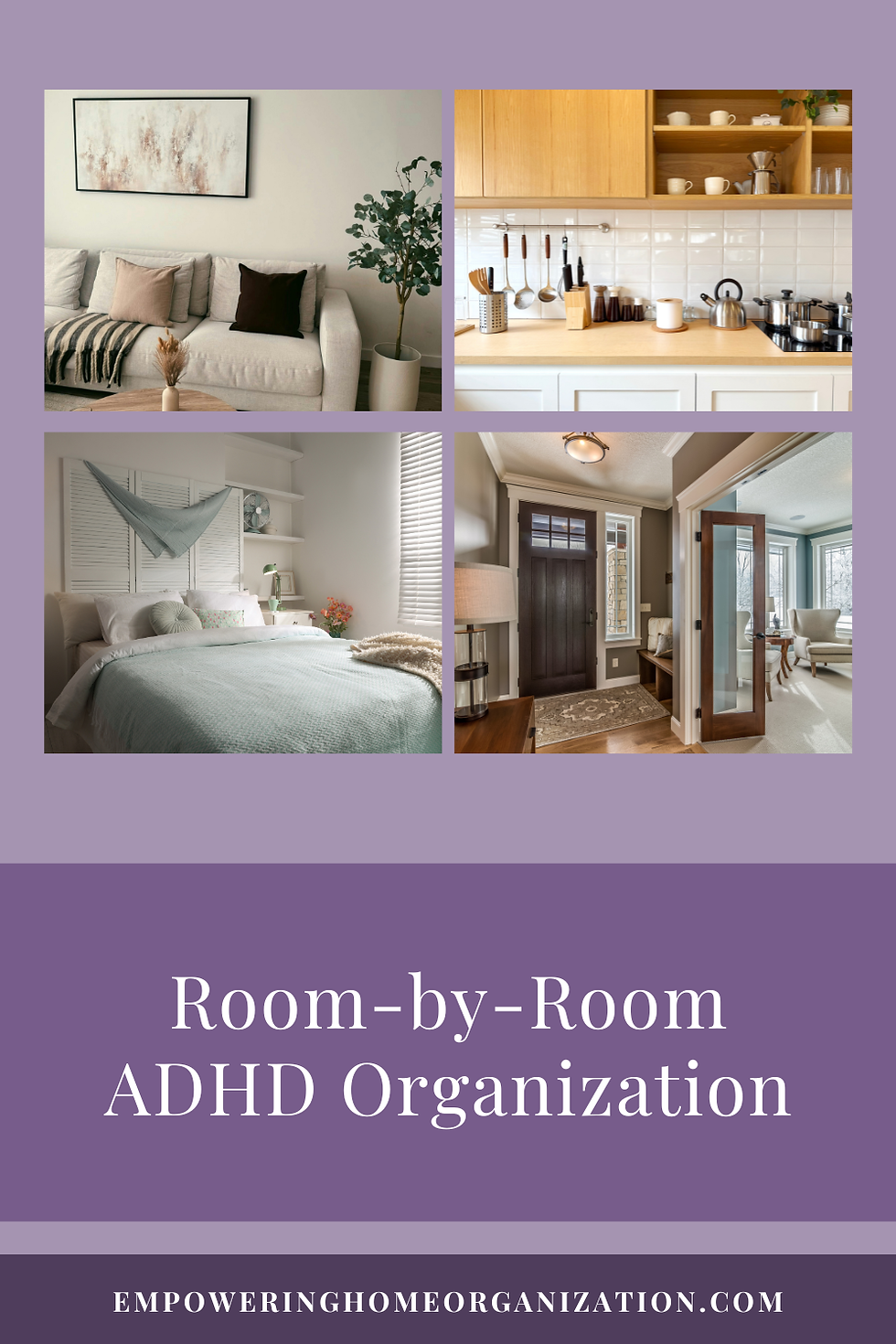
The entryway tends to be the drop zone for everything you bring in the house with you. Coats, bags, shoes, keys etc. Whether the entry point is front door or garage door, it will always be the drop zone because the ADHD brain is already thinking about a million other things before you even walk through the door.
Since we want to work with your brain rather than against it, try some of the following tools to hep keep the chaos under control simply and easily and frictionlessly
Hooks: Hooks will always win over hangers and good intentions. Hanging a coat on a hook takes one second and only one step. Hangers are a multi step process. And your bags can go on the same hooks making them so much more useful.
Trays: Daily items like keys, wallet, and sunglasses all need a place to land, and a tray or small basket is the perfect spot to drop those things. It’s a simple one step task, but it’s helpful the next morning because there will be no wasting time looking for those keys.
Baskets: Tired of the shoe pile on the floor every day? Set out an open basket or bin so there’s one easy step to put shoes away, and everyone knows where their shoes are.
The least amount of steps is the key to maintaining the organization.
Kitchen
Organizing the kitchen is especially tricky because it has so many moving parts. There tend to be more categories in the kitchen. You have food prep, dishes, small appliances etc. And if that’s not enough, the kitchen tends to be the drop zone for pretty much everything like mail, school papers, kids art projects and supplies, and random missing parts to that thingamajig that you aren't even sure how to put back together.
You come in to cook dinner which means gathering all the ingredients, supplies and gadgets. Set all the timers so by the time you finally eat and have to clean up, the brain is already worn out, so who wants to clean up in the kitchen now? You need a more streamlined system so you don’t run out of bandwidth.
Let’s take a look at some of the ways to streamline the kitchen:
Clear Containers*: You need to be able to see what you have if you want to start using it or continue using it. Otherwise you fall into the “out of sight, out of mind” trap. This trap only leads to forgotten food, duplicate purchases, and dinner-time decision paralysis.
Counter Trays: Stop fighting the stuff on the counter. Things like the mail, school papers, charging cords, and those random little toy parts are always going to live there as much as you hate it. Try a small basket for the charging cords or random little toys. A small tray or file holder gives the mail and school papers a place to go. Using these tools will give those items a place to live without looking like a total clutter fest on your counter.
Streamline Cabinets: Putting away the dishes should be easy. Limit the plates and bowls to one place where each can have it’s own stack so you can retrieve and put away with one step. No more toppling piles of plates and bowls. Cups should be easy to get to and put away without stacking them precariously. Pots and pans should be isolated to one cabinet so they can be stored easy and without having to dig out the one you need. When things can’t be put away easily they don’t get put away.
* Don’t purchase containers before you know what you need! Assess what you need to store, and then purchase new items if needed.
Living Room
At some point, all the things from the other rooms will end up here because this is where you all actually live. Blankets, homework, snacks, dishes, devices etc all end up here.
So let’s consider the way this room is actually used, and forget the way you think if should be used:
Baskets and Trays. Are you seeing a common thread here? A large basket by the couch for blankets, A tray on the coffee table becomes home for remotes and books.
Create a Tidy-Up Bin. Find one basket to live in the living room, and use it for the items that don’t actually belong in the living room and sort it all just once per day or whenever you feel inclined but definitely before it gets full. This will help you stop making multiple trips up and down the steps, because we all know what that leads to–distractions in the other rooms, and never actually finishing the task at hand .
Charging Stations. I know you are probably sick of seeing charging cords laying around. But the fact is people charge their devices where they are using them, which could be anywhere. So stop fighting them and simply contain them.
Sometimes baskets and trays are your friend. It allows you to keep the things you use put away but also out at the same time, and where you actually use them. When the baskets and trays are actually used, and used intentionally, they are no longer clutter.
Kids' Spaces and Playroom
Are you the parent of a kid with ADHD? Then you know that the beautifully labeled or color coded organizing system looks amazing and makes you smile when it’s perfectly maintained, but you also know it’s lifespan is only seconds. It’s time to let go of the aesthetically pleasing system.
Here's what actually works in the ADHD home:
Low and accessible storage only. Put the the storage where the kids can reach. This gives them the opportunity to actually put the toys away. If they can’t reach it, they can’t and won’t put it away. But keeping the storage accessible also gives them some freedom to play without having to ask you get their toys for them. It also prevents them from being injured trying to climb the walls to get what they want.
Big Bins: This is a system a kid can actually get down with. Big and open baskets or bins. Kids are not into hyper organizing their toys. If you want them to put the toys away then they system needs to be on their level.
Fewer Categories: Stop with the hyper organization. If you have 30 different categories, your kids will just stop using their stuff. They don’t care about the organization. Limit it to 3-4 broad categories (outdoor stuff, art stuff, blocks or building, and dolls/figures). But remember that even if some legos end up in the dolls bin, it’s OK. It’s just that sometimes the toys get tossed in the wrong bin. Believe it or not, those legos will eventually end up back in the blocks bin.
Picture Labels: Sometimes a picture is worth a thousand words. This way also allows the kids to interpret the organization how they want, and makes more sense to them.
At the end of the day, what matters most is that they toys are put away and not spread all over the floor.
Bedroom
This should be your sanctuary. The place you can relax in. This is where the day begins, and also where it ends. You shouldn’t start or end the day stressed out. But because of the high expectations of the bedroom, it can become a high point of friction. Clothes end up on the chair— you know the one! (or the floor), then you end of misplacing the things you need in the morning or before bed, and your bedroom becomes a place you don’t really love.
A few systems that help:
A Functional Nightstand: Save this space on top the nightstand for items you need before bed or in the morning. Things like your phone/charger, a glass of water, and maybe that book you read at night. This could be a place where another small basket or tray could come in handy for things like hand creme, chapstick and the book so the top of the nightstand doesn’t become too cluttered. Clutter on the nightstand leads to clutter on the brain, and that’s not what you need before bed.
Worn Once Spot: Everyone has those few items that have been worn once but aren’t dirty yet–so they don’t belong back in the closet but they also don’t belong in the hamper yet. They can really be worn again. Designate a certain spot for these items–maybe a hook or folded nicely on top the dresser. This removes the guilt and gives those items an actual home. Just don’t allow this spot to become overflowing with clothes. It can quickly become a huge pile. So if you want to wear it again, do so sooner rather than later.
Tomorrow's Outfit: Mornings are stressful enough as it is, so why not eliminate one more decision. Before bed choose your outfit for the next day and lay it out. Creating a designated spot for it (a hook on the closet door, or folded on top the dresser) can help you make this a habit.
Strategic Hamper Placement: Be intentional with the placement of the hamper. Keep the hamper near where you actually get undressed so your clothes actually make it to the laundry room on laundry day. If you have to walk to the opposite side of the room or different room completely the hamper will go unused, and things will get missed on laundry day. (I could write an entire article of laundry, and I have. You can read it here)
Bathroom
Bathrooms may be small but they sure are mighty when it comes to creating chaos out of all the many products it contains. Think about all the hair products, skincare products, oral care items. It all adds up and can take off the entire counter top.
If you already have a pretty clear and established habit for most of the bathroom routines, like hair, skin and teeth, then some of these items can be kept in medicine cabinets or drawers. But like I’ve said over and over again–”out of sight means out of mind” and you could easily forget your skincare routine if the stuff is in a drawer or cabinet. Clear containers can be helpful for containing all like items (one for skincare, one for hair, one for toothcare), but don’t overfill them. If it doesn’t fit easily, it won’t stay organized.
Here are a few other tweaks that make a real difference:
Keep daily items in sight: This might feel messy, but again–out of sight out of mind is real! A small tray or small bin to contain the items can keep them looking intentional instead of messy and you won’t forget a step in the routine.
Drawer Dividers. Drawers can be used for the daily stuff only if you are already really on your game for the hair and skincare routines. For that reason they are much better suited for backup supplies, but they should be clearly organized so you can see they supplies you have. If you toss everything loose into a drawer and have to dig around to find something you will give up everytime. And this just leads to overbuying supplies you already have and eventually running out of space to keep them all. This is how you end up with piles all over the bathroom.
Hooks for the Win: Remember using hooks for coats instead of hangers in the entryway? Well the same goes for the bathroom. Towel bars create the friction that derails any system and hooks can take it away. Hooks all the way.
The DOOM Piles
DOOM = Didn’t Organize, Only Moved.
You know the piles I am talking about. The stuff you pile up to deal with later, and get moved to rooms that are not often used. You know these too...the spare room, or office, and the corner in the basement. These piles reproduce too! You may start with one but then you realize you have a dozen of them, and they are in various places.
DOOM piles usually consist of items that don’t have a home. Then they collect in a room or space that becomes the default holding zone for everything without a clear destination. But the piles reproduce because we keep creating new piles whenever we have company over or need space on the kitchen counter or dining room table.
The good news is you don’t need a marathon organizing session to tackle these piles (which is exhausting and hard to sustain for ADHD brains). You need better systems where things should live first, so items have somewhere to actually go.
When you have the systems in place and things have a clear home the piles stay small— and clearing it out becomes much more manageable.
The Main Takeaway: Systems Over Willpower
It’s not about working harder at the organization. It’s about designing a better system.
If you have the proper system in place–one that works for your brain, then organization stops feeling like a constant fight, and becomes second nature.
This is exactly what professional organizers do. We create the system that works for you not someone else. We don’t just tidy up and put things “away”. The ADHD-friendly system is not one certain system. It’s whatever system makes daily life easier for you.
If you’re ready for more practical organizing tips, sign up for my newsletter — I share real, doable ideas every month as well as business updates and special offers.
Happy Organizing,
Lisa
Additional Resources for ADHD Education
CHADD (Children and Adults with ADHD)

Comments